
Land around Columbia is selling in all sizes, from one-acre building lots near Spring Hill to 40-acre tracts off county roads toward Culleoka and Santa Fe. A lot of it has not been worked in years. Here is what to check first, in roughly the order it matters.
1. Where are your corners?
On older Maury County tracts, fences often do not sit on the property line, and deeds may describe corners by trees or rocks that are long gone. Find the pins or have the land surveyed, then flag the lines where clearing will come close. It is the cheapest insurance you can buy.
2. Sinkholes and caves
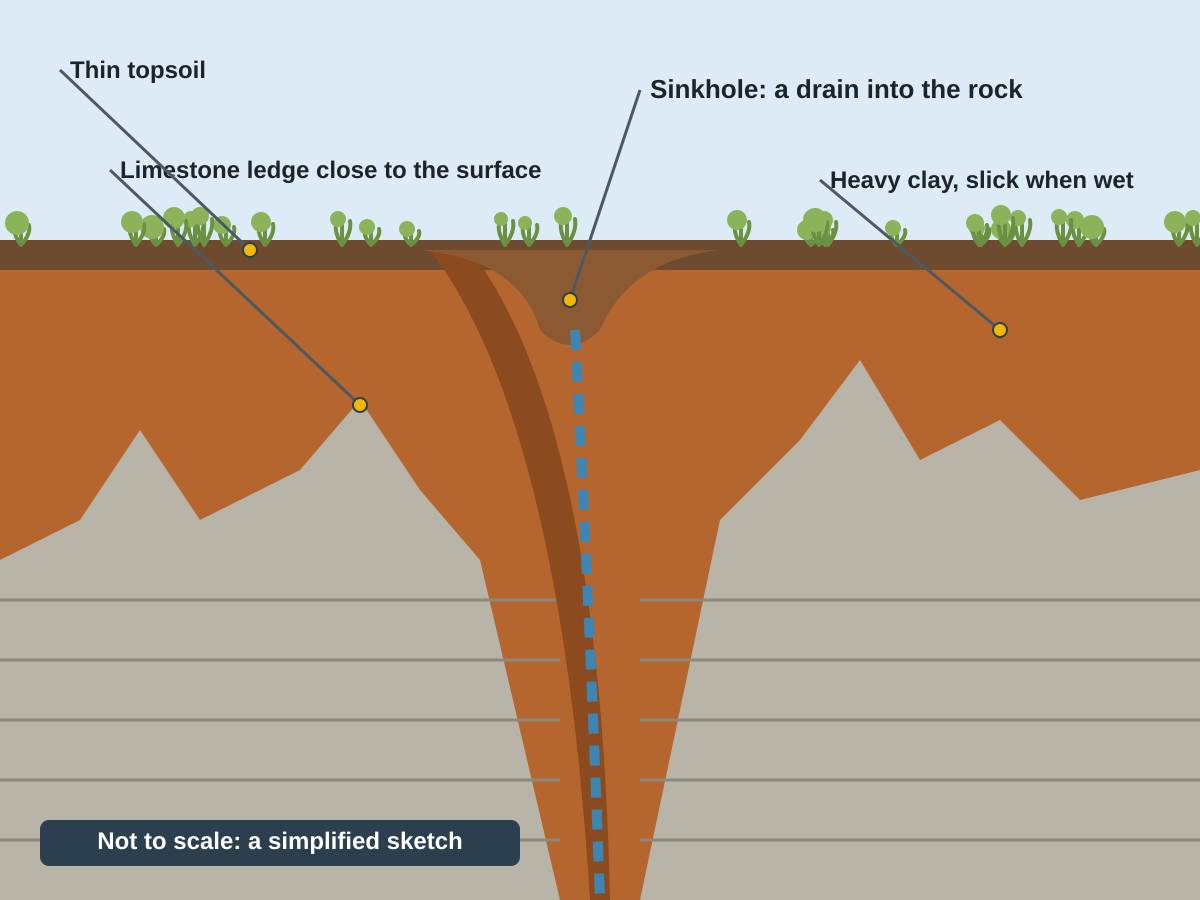
Much of Maury County is karst: limestone bedrock riddled with cracks, caves and sinkholes, capped by clay. A sinkhole might be a gentle bowl in the woods or an open throat. It drains straight to the groundwater that feeds wells and springs. Mark every one you find. Keep them out of the building area, leave a vegetated buffer around them, and never let anyone fill one with stumps or brush.
3. How close is the rock?
Limestone ledges can sit within a foot or two of the surface on some ground, especially on the thin-soiled knobs where cedar grows best. Rock changes clearing costs (stump pulling brings it up), foundation plans (a basement may mean blasting or hammering) and septic options. Probing a few spots, or asking a local excavator who has worked nearby, gives an early warning.
4. Where will the house, drive and septic go?
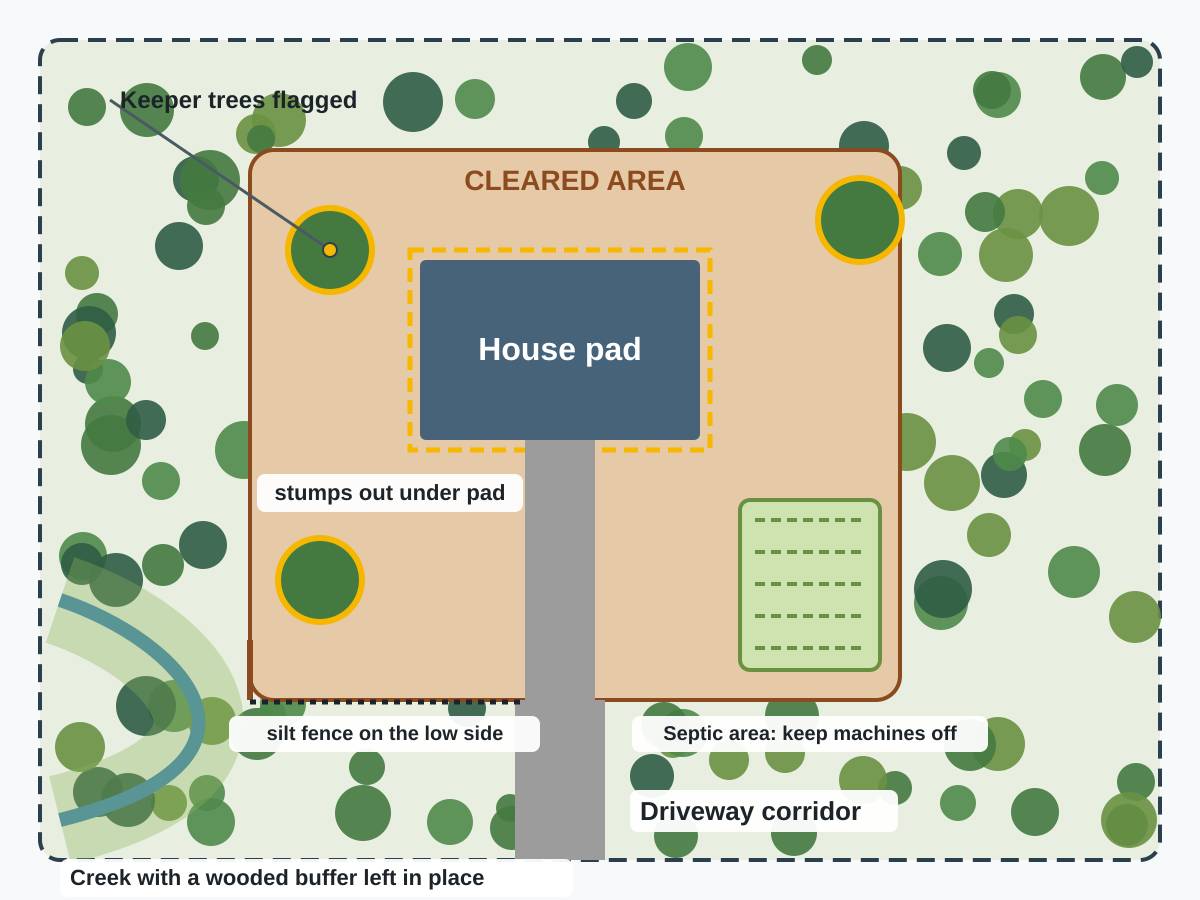
Decide this before clearing, not after. Outside sewer service, the septic field location depends on a soil evaluation, and machines driving over that ground can compact the soil. A rough sketch showing the house pad, a driveway corridor, the septic area and the trees to keep lets a contractor clear exactly what you need and price it accurately.
5. Creeks, springs and wet spots
Walk the land after a rain. Mark every creek, wet-weather branch, spring and soggy spot. Work in or across streams generally needs a state permit from TDEC, driveway crossings need properly sized culverts, and if you are near the Duck River or its tributaries, ask TDEC what protections apply. Plan a wooded buffer along the water.
6. Is there timber worth selling?
Straight, sizable hardwoods such as white oak, red oak, black walnut and hickory can have real value. Cedar, hackberry and brush usually do not. If you have timber, a consulting forester can mark and sell it before clearing, which can offset part of the cost. The Tennessee Division of Forestry can help you find one. Once logs are pushed into a burn pile, that value is gone.
7. Access for the equipment
Mulchers and excavators arrive on a trailer behind a truck. Check gate width, the turn off the road, soft spots on the field road and any creek crossing. In a wet winter, Maury County clay can make a field road impassable. If a new drive is part of the plan, clear it first so everything else can get in.
8. Utilities, above and below
Look up for power lines crossing the land or running along the road, since tree felling near them is dangerous and may need the utility involved. Look down, too: call Tennessee 811 before any stump pulling or grading so buried lines are marked. Mark your own private lines (to a well, barn or shop) yourself.
9. Which rules apply to your address
Inside Columbia, Spring Hill or Mount Pleasant city limits, expect city permits for land disturbance and burning. Outdoor burning near woods, grass or brush needs a free state burn permit from October 15 to May 15, and disturbing an acre or more of soil for construction can need state stormwater coverage from TDEC. The full list, with who to call, is in our Maury County land clearing rules guide.
Then decide how to clear
With those answers, the method mostly chooses itself: full clearing where you build and drive, forestry mulching for pasture, trails and edges, and nothing at all where the woods are fine as they are. Read forestry mulching or full clearing? and check planning ranges in the cost guide.
Get connected with a local clearing pro
When you are ready, a contractor who works in Maury County can walk the land with you and price it. Call (931) 534‑0398 or request an estimate, and we'll connect you with an experienced, qualified local professional. For building sites, see lot clearing.