
The plants you are usually fighting
- Eastern red cedar. The signature tree of Middle Tennessee's limestone country. It seeds into open ground, grows dense and shades out grass. It does not resprout from a low stump, which makes it one of the easier plants to get rid of for good.
- Chinese privet. An escaped hedge shrub that forms thickets along creeks, fence rows and woods edges. It resprouts from roots and spreads by seed.
- Bush honeysuckle. Amur honeysuckle leafs out early and holds its leaves late, smothering everything under it. Japanese honeysuckle vine climbs over the rest.
- Hackberry, sumac and sassafras. Fast colonizers of abandoned fields. Hackberry in particular grows into sizable trees along fence lines.
- Blackberry, greenbrier and multiflora rose. The thorny layer that makes overgrown land nearly impossible to walk.
Where brush clearing makes the biggest difference
- An old homeplace or family farm being cleaned up for a sale or a new house
- A backyard that the woods took back, common on older lots in Columbia and Mount Pleasant
- Creek banks and woods edges choked with privet, where clearing has to be careful near the water
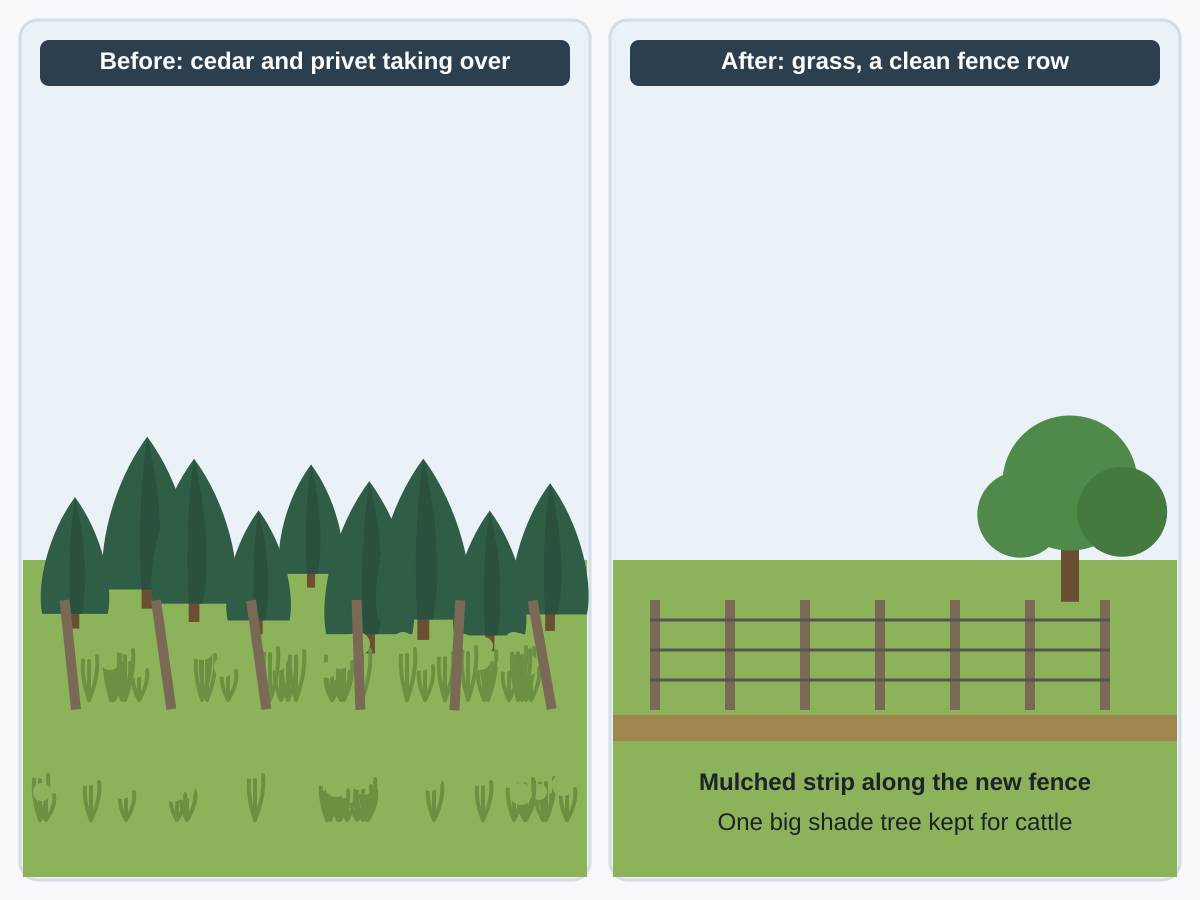
- Pasture edges and fence rows; see pasture and fence line clearing
- Hunting land where shooting lanes and food plots need reopening
How brush and cedar are usually cleared
Forestry mulching
For dense cedar and brush up to a few inches across, a forestry mulcher is usually the fastest and cleanest method. Everything is ground in place, the soil stays covered and there is nothing to burn.
Cut, pile and burn or haul
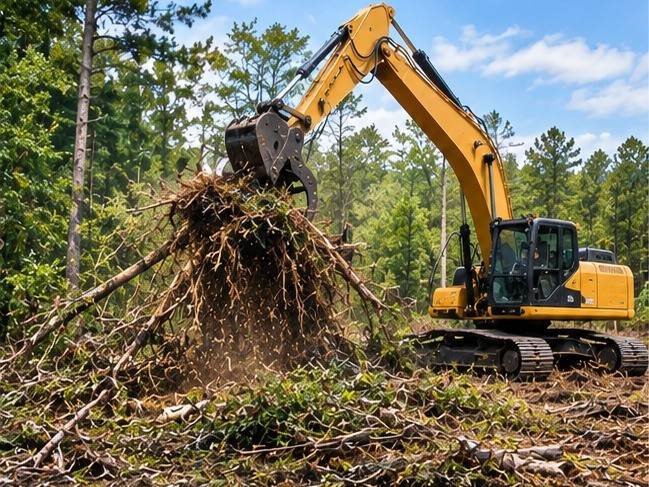
Where cedars are larger, or where the owner wants bare ground, a crew with an excavator, a grapple and saws cuts the brush, piles it and either burns it in season or hauls it off. Burning requires a Division of Forestry permit between October 15 and May 15, and inside city limits the city may restrict it. The Maury County clearing rules guide covers the details.
Hand clearing near water and trees you keep
Along a creek bank, around a spring or under a prized shade tree, a crew with saws may do the close work that a machine should not. Leaving a strip of vegetation along streams protects the bank from washing out, and work in or across a stream can need a state permit, so ask TDEC first near the Duck River or its creeks.
Follow-up
Privet, honeysuckle and hackberry come back from the roots. Plan on mowing, grazing or a targeted herbicide treatment the next growing season. Cedar stays gone if it was cut below its lowest green limbs, but new seedlings will arrive.
What drives the cost of brush and cedar clearing
- Density: a solid cedar thicket takes much longer than scattered bushes
- Stem size: cedars over six or eight inches change the equipment needed
- Hidden hazards: old fence wire, T-posts, tin and trash in the brush
- Debris plan: mulched in place, burned in season or hauled off
- Access and slope: steep hillsides and soft spring-fed ground slow machines
- Follow-up: whether regrowth treatment is part of the job
See per-acre planning ranges in the land clearing cost guide, or call (931) 534‑0398 to get connected with a pro for a price on your property.
Questions to ask before you hire
- Will you mulch, burn or haul, and who handles the burn permit if you burn?
- How close to the creek will you work, and what will you leave along the bank?
- Do you pull old fence and wire, or should I have that done first?
- What will the ground look like when you leave?
- Do you offer follow-up treatment for privet and honeysuckle regrowth?
- Can you show proof of liability insurance?
Get connected
Tell us where the property is, about how much ground is overgrown and what you want to do with it. We'll connect you with an experienced, qualified local professional who clears brush and cedar in Maury County.