
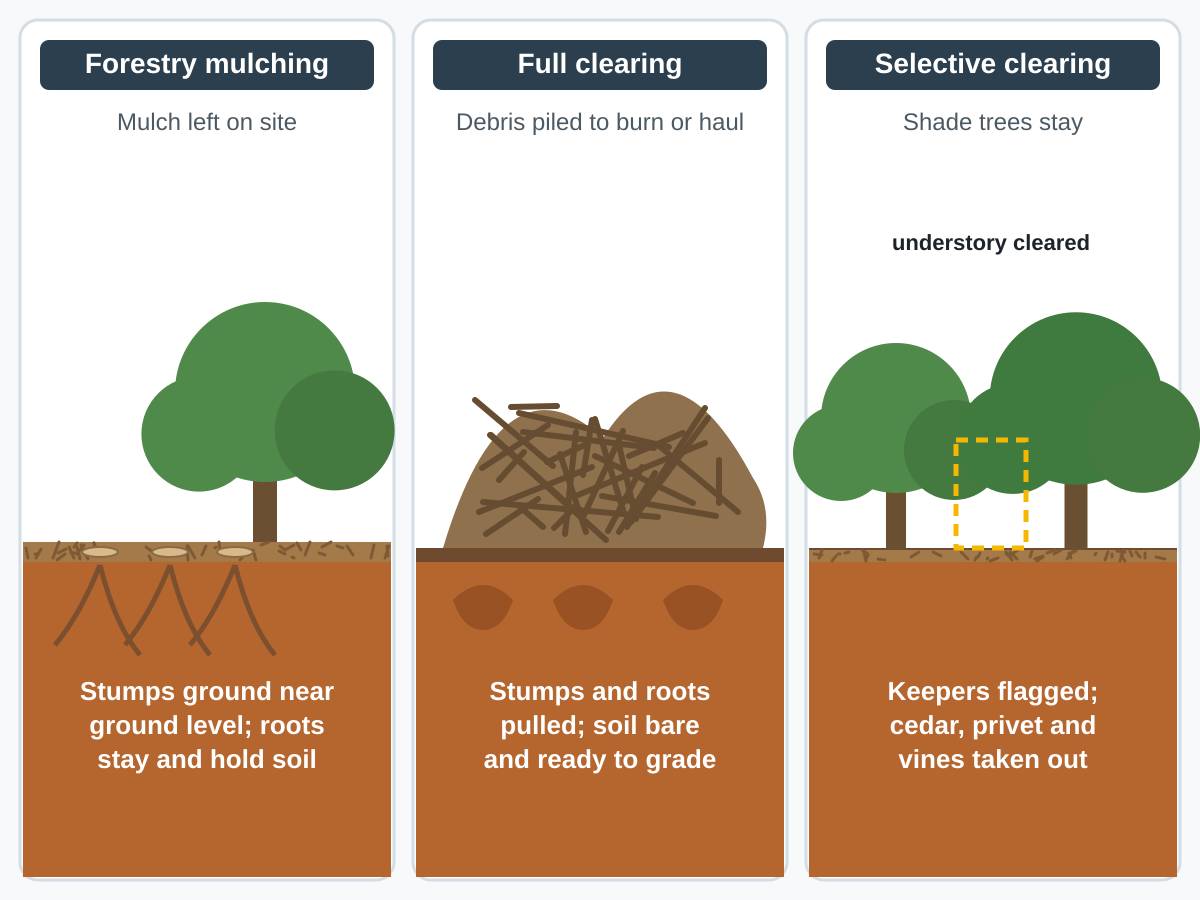
If you have called around about clearing land near Columbia, you have probably heard two very different pitches. One contractor brings a single tracked machine with a spinning drum and talks about getting it done in a day with nothing to burn. Another talks about an excavator, a dozer, stump holes and burn piles. Neither is wrong. They are describing two different finished products, and which one you need depends on what happens to the land next.
What forestry mulching does
A forestry mulcher is a heavy rotating head with carbide or steel teeth mounted on a skid steer or a dedicated tracked carrier. It grinds standing brush and trees from the top down and leaves the chips where they fall. Stumps end up near ground level, and the root systems stay in the soil.
That combination suits the land that makes up so much of Maury County: old pasture and hay ground that grew up in eastern red cedar, privet, honeysuckle and hackberry after the cows left. One pass turns an impassable thicket back into open ground, with the clay still held by roots and covered by chips. There is no burn pile, no hauling, and nothing to wait for a burn permit day.
Its limits are just as clear. Large hardwoods are slow or impractical for many mulchers; ask the contractor what size their machine handles. Rock ledges and old wire are hard on the teeth. And the stumps and roots it leaves are a problem anywhere you need firm, stable ground.
What full clearing does
Full clearing, sometimes called grubbing or push-and-pile clearing, removes everything: trees are felled, stumps and roots are pulled with an excavator or pushed out with a dozer, and the debris is piled. The result is bare soil you can grade, compact and build on.
That is what a house footing, a barn slab, a basement or a gravel driveway needs. It also means dealing with the debris: burning it during permit season where that is allowed, grinding it, or hauling it away. And it means bare clay that will wash in the next hard rain unless it is protected. Once an acre or more of soil is disturbed for construction, state stormwater rules can apply. See the Maury County clearing rules guide for burn permits, stormwater and streams.
Side by side
| Forestry mulching | Full clearing | |
|---|---|---|
| What it leaves | A layer of wood chips over the soil; stumps near ground level; roots in place | Bare soil; stumps and roots removed; debris in piles |
| Best for | Pasture, fence rows, trails, views, hunting lanes, understory under keeper trees | House pads, slabs, basements, driveways, anything to be graded |
| Tree size | Brush, cedar and small trees; large trunks need other equipment | Any size, with saws, excavator and dozer |
| Erosion risk | Low: soil stays covered and rooted | Higher until the ground is seeded or built on |
| Debris | None to handle; it becomes the mulch | Must be burned in season, mulched or hauled |
| Regrowth | Cedar stays gone; privet and honeysuckle resprout and need follow-up | Less resprouting where roots are pulled |
| Typical cost per acre | Often lower for brush and cedar | Higher, especially with stump removal |
Which method for which job
A cedar-choked pasture
Mulching, almost every time. The cedar does not resprout from a low cut, the ground stays covered, and stumps end up low enough to mow over once they settle. Follow with a soil test, lime and seed. See pasture and fence line clearing.
A wooded homesite
Both. Full clearing inside the house footprint, a working margin and the driveway; mulching for the yard and edges; and the best shade trees flagged and left. Keep machines off the septic area. See lot clearing for homes, barns and driveways.
Trails, hunting lanes and views
Selective mulching. Open the lanes or sight lines and leave the rest of the woods standing.
A long driveway through woods
Full clearing in the travel lane and ditches, with stumps removed so gravel does not sink. Mulching can widen the shoulders cheaply.
A tract being sold
Often light mulching to open it up so buyers can see the ground, leaving decisions about building sites to them.
The stump question decides the price
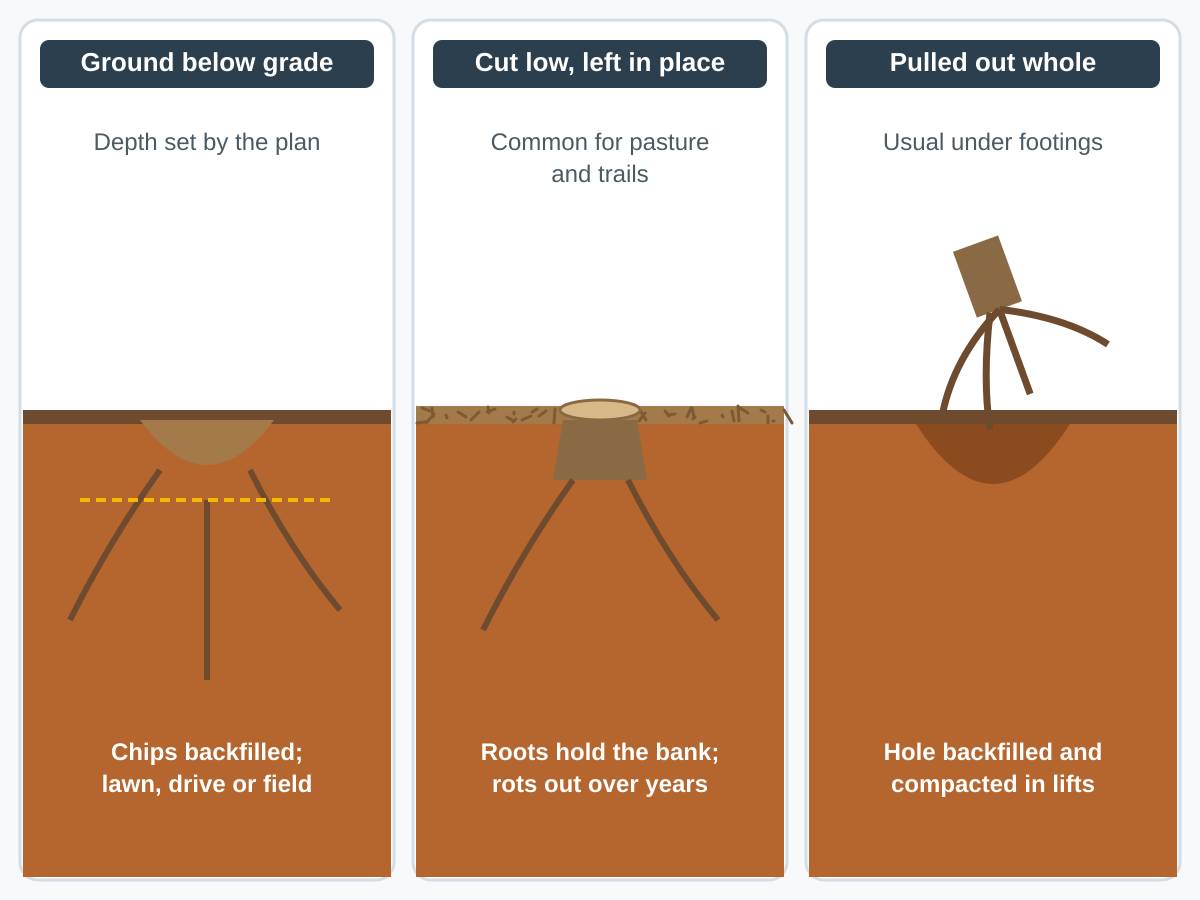
More than anything else, what happens to the stumps moves the cost. Mulched-low stumps are part of the mulching pass. Grinding them below grade costs more. Pulling and backfilling each one costs the most. Decide by area: pull where you build, grind where you mow closely, leave low everywhere else. The stump removal page explains each option, and the cost guide has planning ranges.
Local conditions that tip the choice
- Limestone near the surface: pulling stumps can bring up rock and leave big holes; mulching avoids digging.
- Sinkholes: mulching leaves them undisturbed; never push debris into one.
- Clay and spring rain: bare ground cleared in March is the most likely to wash. Mulch covers it as it is cut.
- Burn rules: full clearing often means burning; inside city limits that may not be allowed, which pushes jobs toward mulching or hauling.
Talk it through with a local pro
Tell the contractor what the land is for before asking how they would clear it. We'll connect you with an experienced, qualified professional who works in Maury County: call (931) 534‑0398 or request an estimate. More on the method itself: forestry mulching.