
This is general information, not legal advice. Rules change, and the agency responsible has the final word. Details, fees and thresholds can change, so check the current rule with the office listed before you rely on it.
The rules at a glance
| Rule | When it applies | Who handles it |
|---|---|---|
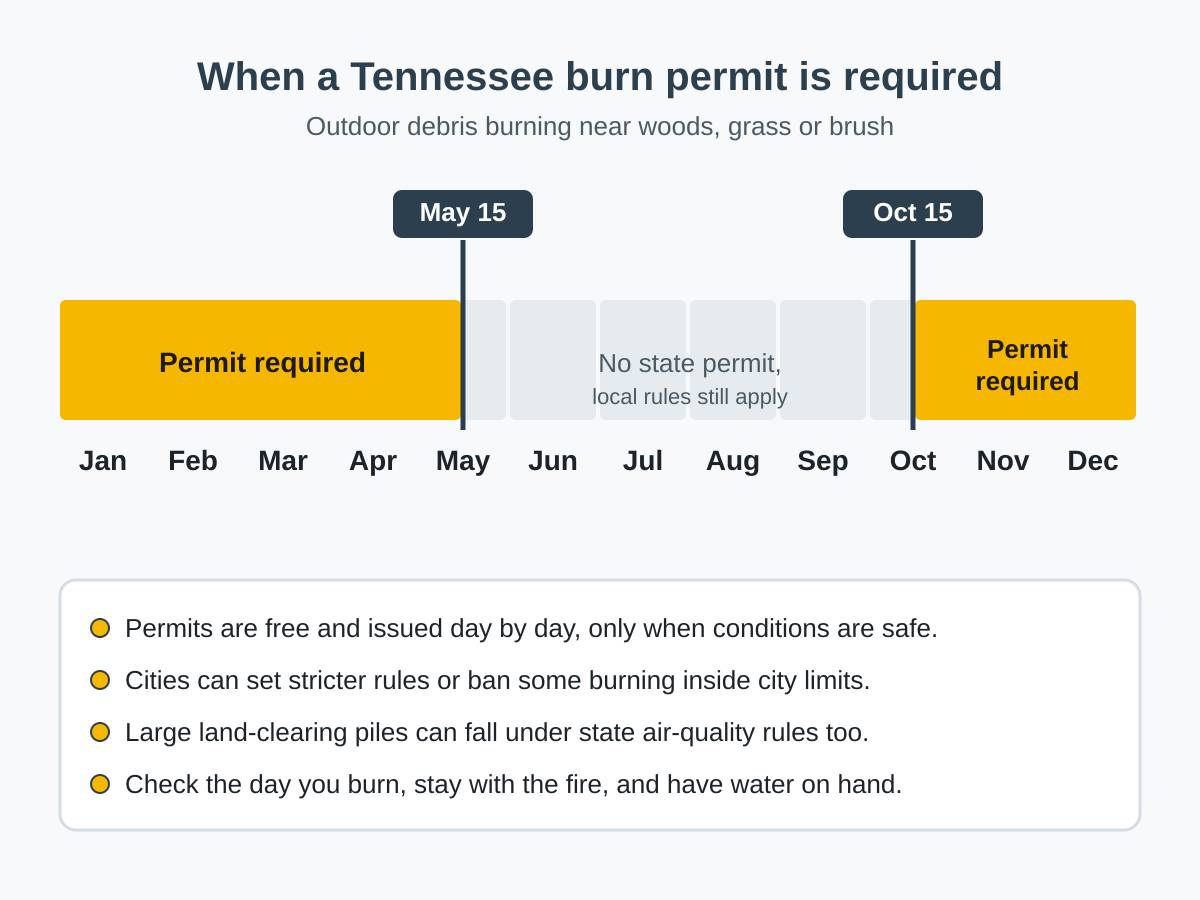
| Burn permit | Burning brush or debris outdoors near woods, grass or brush from October 15 through May 15 | Tennessee Division of Forestry (state); inside city limits, also check with the city fire department |
| Open burning (air quality) | Large land-clearing burns can also fall under state air-quality rules | TDEC (Tennessee Department of Environment and Conservation) |
| Construction stormwater permit | Construction that leaves a large area of soil bare, generally an acre or more | TDEC (state); ask before work starts |
| City land disturbance / grading permit | Clearing and grading inside city limits may need a city permit | The planning or engineering office of Columbia, Spring Hill or Mount Pleasant |
| Stream work permit (ARAP) | Work in or across a stream, spring or wetland: culverts, crossings, bank clearing | TDEC; sometimes the U.S. Army Corps of Engineers |
| Tennessee 811 ticket | Any digging, including stump pulling, grinding and grading | Tennessee 811 (the state one-call center) |
| Contractor license | Larger jobs can require a state contractor license; ask the Board which jobs need one | Tennessee Board for Licensing Contractors |
1. Burning debris: the state burn permit season
Burning is the oldest way to get rid of clearing debris in Middle Tennessee, and it is the rule that trips people up most. From October 15 through May 15, outdoor burning near forest, grassland or woodland needs a burn permit from the Tennessee Division of Forestry. Permits are free and are requested for the day you plan to burn; the Division of Forestry can tell you how to apply. When winds are high or conditions are dry, the Division stops issuing them until it is safe again.
A few points that matter for land clearing specifically:
- Only natural vegetation. The state permit covers brush and wood grown on the land. Tires, lumber, shingles, plastic and household trash do not belong in a burn pile at any time of year.
- Big piles can bring in air-quality rules. Large land-clearing burns can also fall under the state's air-quality rules for open burning. If you are planning a big burn, ask TDEC what conditions apply.
- Cities have their own rules. Inside Columbia, Spring Hill or Mount Pleasant, ask the city fire department before you burn. Cities can require their own permit or ban some burning outright.
- Counties can go further. In a drought, burn bans can be declared locally even in permit season.
Practical advice: keep piles well away from woods edges, buildings and power lines; never burn in or next to a sinkhole; have water and a way to push the pile in; and stay with the fire until it is out. Cedar burns hot and throws embers. If burning sounds like more trouble than it is worth, forestry mulching avoids it entirely.
2. Bare soil: the 1-acre stormwater line
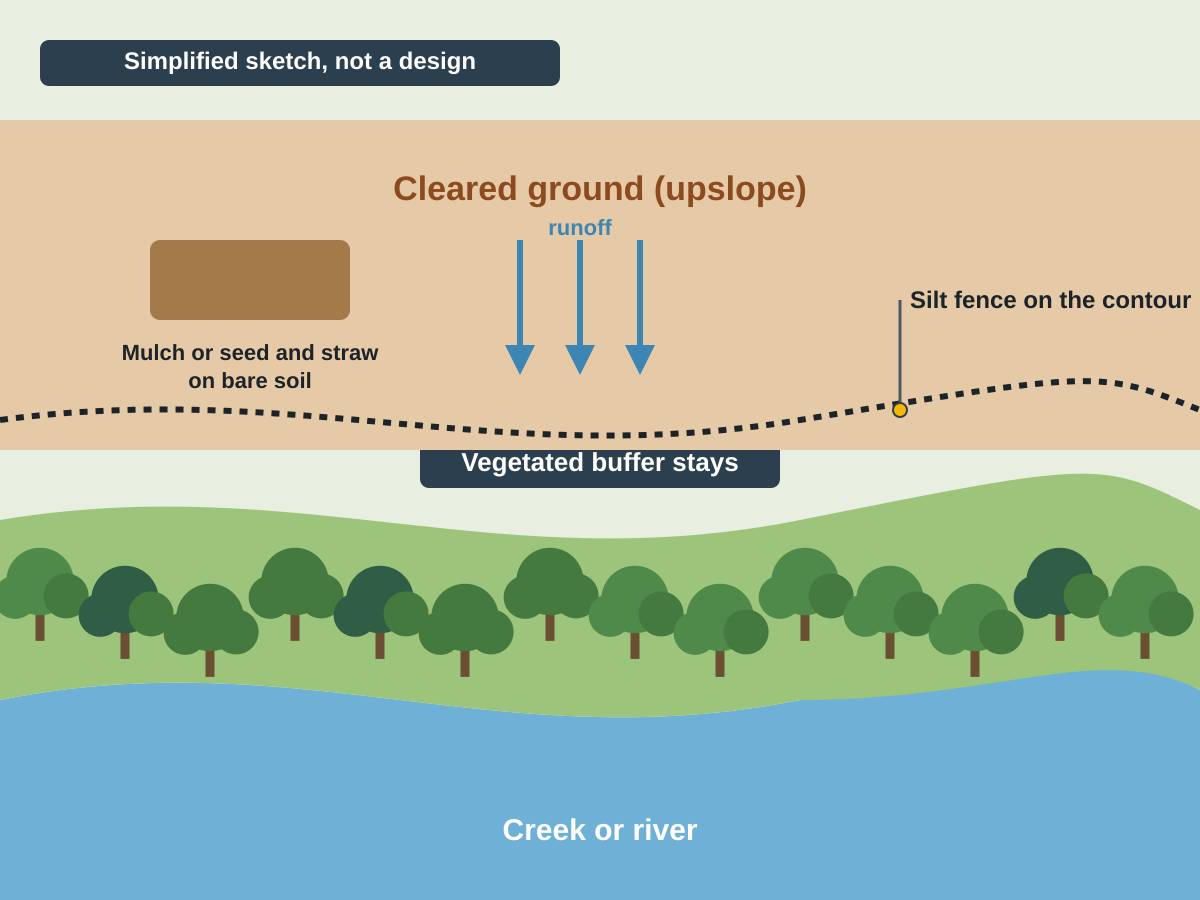
Tennessee's construction stormwater general permit, administered by TDEC, generally applies to construction that disturbs an acre or more of land, and can apply to smaller sites that are part of a larger development. Coverage is arranged with TDEC before work begins and comes with an erosion control plan: silt fence, a stable construction entrance, and covering bare soil quickly. TDEC can tell you whether your project needs it.
For landowners, the key questions are how much soil will be bare at the same time, and whether the clearing is part of building something. A five-acre homesite where two acres are grubbed and graded for the house, barn and drive is a very different case from five acres of pasture mulched with the roots left in. If you are near the line, ask your contractor, builder or engineer before work starts, not after.
Inside city limits, the cities add their own layer. Columbia, Spring Hill and Mount Pleasant each have their own stormwater and land disturbance requirements, so ask the city's planning or engineering office before clearing and grading inside city limits.
3. Creeks, springs and the Duck River
The Duck River runs through the heart of Maury County, past Columbia and on to Williamsport. It is known for an unusual variety of freshwater mussels and fish, and it gets a lot of state attention as a result. Protections for the river and land along it can change, so if your property is near the Duck, ask TDEC what applies before a large clearing project.
Anything done near the river or its creeks deserves care:
- Work in or across a stream needs a permit. Culverts, driveway crossings, clearing the bank itself, and work in wetlands generally need an Aquatic Resource Alteration Permit (ARAP) from TDEC, and sometimes federal approval. Ask TDEC before anything is dug.
- Leave a buffer. A strip of trees and shrubs along the bank holds the soil and filters runoff from the cleared ground above. The wider the better; the TN Division of Forestry or TDEC can suggest a width for your creek.
- Keep bare soil out of the water. Clay washing off a cleared hillside is the most common way clearing harms a creek. Silt fence and fast cover are the fix.
4. Sinkholes and karst
Much of Maury County sits on limestone, and sinkholes are common in parts of the county. A sinkhole is an open drain into the groundwater that feeds springs and wells. Never push stumps, brush or fill into one, never burn in one, and keep machines and bare soil away from its edges. Changing a sinkhole so it takes stormwater can also fall under state rules, so ask TDEC first.
5. Inside Columbia, Spring Hill or Mount Pleasant
Unincorporated Maury County has relatively few local permits for clearing. The cities are different. Inside city limits, expect land disturbance or grading permits for construction, burn permits through the fire department, and possibly tree or landscape rules in subdivisions and commercial areas. The city planning office can tell you what applies. Spring Hill straddles the Maury and Williamson County line, so an address just outside Spring Hill can fall under either county. Subdivision HOAs add their own approvals on top.
6. Digging: call Tennessee 811 first
Tennessee law requires anyone digging to contact Tennessee 811 in advance so buried utilities can be marked. Call or file a ticket several working days before work starts; Tennessee 811 will tell you how long to wait. Stump pulling, stump grinding, grading and ditching all count. Private lines you installed yourself, like a line to a barn or well, are not marked by the utilities, so point those out to the contractor.
7. Contractor licensing and insurance
In Tennessee, larger construction jobs require a state contractor license from the Board for Licensing Contractors, and grading and site work have their own license classifications. Many small clearing jobs do not need one, but a large homesite or acreage job may. Ask the contractor whether your job needs a license and whether they hold it, and check with the Board if you are unsure. Regardless of size, ask for a certificate of liability insurance before anyone starts, and check that it is current.
8. If you plan to build: septic and the soil test
Outside sewer service, a new house needs a septic system permit, which starts with a soil evaluation of the proposed field area. Ask the state septic program (TDEC) about the process for your lot. Heavy machines driving over that area can compact the soil and affect the result, and clearing the wrong spot can remove shade trees you would have kept. Talk to your builder about the order of operations before clearing a homesite. See lot clearing for homes, barns and driveways.
Printable checklist: before the first tree comes down
Maury County land clearing checklist
- Find and flag your property corners (survey if in doubt)
- Look up whether the land is inside Columbia, Spring Hill or Mount Pleasant city limits
- Mark creeks, wet-weather branches, springs, sinkholes and wet spots on a sketch
- Decide what the land is for, and what should stay wooded
- If you will build: talk to your builder and the septic program before clearing
- Estimate how much soil will be bare at once (around an acre or more, ask TDEC about stormwater coverage)
- Choose mulch, burn or haul for the debris
- If burning: plan for the permit season and city rules; never burn in a sinkhole
- If crossing or working next to a stream: ask about an ARAP before anything is dug
- Call Tennessee 811 before any stump pulling or grading
- Ask for the contractor's insurance certificate and, on a larger job, their state contractor license
- Plan silt fence, mulch or seed for bare ground before a rain
From landclearingcolumbiatn.com. General information only; confirm current rules with the responsible agency.
Using this guide
Realtors, surveyors, builders and extension agents are welcome to link to this page for clients buying or developing land in Maury County. Please link rather than copy, so readers always get the current version.
Need a contractor who knows these rules?
We connect landowners in Columbia, TN and across Maury County with experienced, qualified local clearing professionals. Call (931) 534‑0398 or request an estimate. For more before you start, read 9 things to check before you clear and the land clearing cost guide.